Why Woven Baskets Hold Their Shape
Why woven baskets hold their shape comes down to crossings, tension, and material choice. Learn how to inspect a basket and judge whether it suits its job.
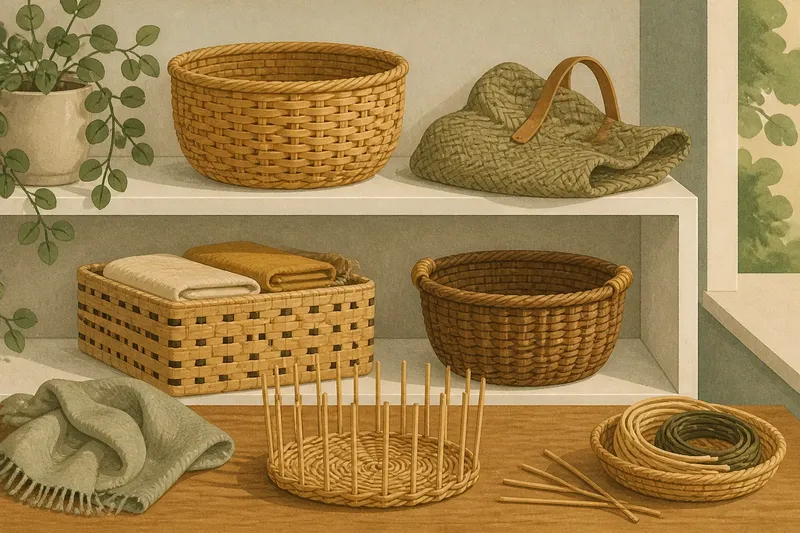
An empty basket on a shelf can keep its round sides while a soft tote beside it folds flat. Why woven baskets hold their shape comes down to how strands cross, how firmly they sit together, and how the base and rim support the walls.
Those details also help you judge whether a basket suits its intended job. A basket for folded scarves has different demands from one you plan to carry by its handles, and a few simple observations can make the distinction clearer.
Crossings share pressure
In a typical basket, upright elements—often called stakes or spokes—form a framework. Weavers pass other strands around and between them. Each crossing limits how far a neighboring strand can shift, so the basket acts less like a collection of loose lines and more like a connected shell.
Press gently against a woven side and nearby strands resist together. Pressure travels through several intersections, then into the base and around the basket. That shared response helps the wall remain curved or upright instead of folding at one point.
Imagine you are choosing a basket for scarves. One has widely spaced uprights and only a few crossing strands; another has closer crossings that sit evenly together. With a light touch, the first basket’s side may shift more visibly. That observation does not predict every aspect of its use, but it gives you a useful clue about how its wall responds to pressure.
Tension seats strands
Crossings help most when the strands stay in contact. During weaving, each new strand is drawn into place with enough tension to sit snugly against its neighbors. Friction between the strands resists sliding. If the weave is loose, a strand may wander; if it is too tight, a brittle material may split or a curved wall may become uneven.
Tension can vary around a basket. The rim, base, and corners call for different handling because the weave changes direction there. A well-formed rim often binds the upright ends together, while closely packed strands at the base create a stable starting platform.
Look for strands that sit against one another rather than hovering across conspicuous gaps. Small variations are natural in handwork. A loose patch that lets a strand slide freely is a more useful sign to consider than minor differences in spacing.
Curves need flexibility
A basket wall is curved because its framework and weaving are shaped while the materials can still bend. Flexible strands can follow a rounded path without snapping, and the crossing pattern helps them hold that path after the bend is made. The form depends both on a strand’s resistance to bending and on the weave’s restraint against slipping.
A strand with little flexibility may resist a tight turn and crack. A very soft strand may bend readily but need a denser weave or stronger framework to stay upright. Broad, flat strips also behave differently from round rods: their width and direction affect how sharply they can curve.
Look at corners and transitions. A square storage basket asks its materials to make different turns from a rounded laundry basket. Reinforced corners or extra crossings may help square walls meet cleanly; on a rounded form, the framework can distribute the curve around the body.
Materials leave clues
Plant fibers are not interchangeable. Willow can be bent into flowing lines; reed is often comparatively firm; seagrass and similar grasses can form broad, textured bands. Paper cord, cane, and other materials bring their own balance of flexibility, surface grip, and stiffness. Preparation matters too: a split, peeled, bundled, or twisted strand behaves differently from the raw material.
Touch and sight offer practical clues. A smooth, rounded strand may slide more easily at a crossing than a rough, flat one. A thick strand creates a more prominent line but also takes up more room in the pattern. Look for cracks, fraying, or crushed sections, and consider whether the material seems suited to gentle storage, frequent carrying, or display.
Color can reveal construction. If the uprights and crossing strands differ in tone or texture, trace their paths to see how they alternate over and under. That small bit of visual detective work can make the pattern easier to understand.
Patterns restrain movement
In a plain over-under weave, each strand passes over one upright and under the next. Frequent crossings make the structure easy to read and help keep neighboring elements in position. Other patterns may use paired strands, diagonal movement, or a tighter decorative band. The pattern changes where strands touch and how they resist shifting.
A diagonal pattern carries lines across the basket at an angle, while paired weaving places two strands together as they travel around the framework. A decorative pattern is not automatically stronger than a simple one. For a particular job, an even plain weave may support a shape better than an intricate open design.
Check the base-to-wall transition, where the weave turns upward. A neat, continuous transition suggests that strands have been guided into the new direction without leaving a slack pocket. That detail may matter more to the basket’s shape than an elaborate visible pattern.
Bases and rims finish frames
The base anchors the uprights and gives the walls a place to rise from. A flat, firm base helps a basket sit steadily; a woven base can spread the contents’ pressure across several strands before it reaches the sides. If the base flexes noticeably, the wall may tilt or change angle as the basket is filled.
The rim closes the upper edge and gathers the upright strands. It may be rolled, bound, or finished with a separate piece. A secure rim limits splaying, the outward drift that can make a basket flare or lose its outline. Follow the edge with your eyes and notice whether the finish continues evenly or has a loose, interrupted section.
Handles add another demand because their attachment points concentrate pulling force. Makers may wrap or reinforce the surrounding weave. On a handled basket, notice whether each handle base connects into several strands or appears to rely on one narrow point.
Shape shifts with use
Woven material responds to its surroundings and to handling. A basket may gradually settle into a different outline as strands bend, rub, or relax. Repeated pressure against one side may encourage a lean, while lifting by a weak area can distort the rim. A basket holding light linens has different demands from one carrying books across a room.
If a basket looks distorted, remove its contents and let the weave rest rather than twisting it suddenly back into shape. For material-specific reshaping or cleaning, follow the maker’s care guidance. The right method depends on the fiber and finish.
It is not worth scrutinizing every tiny irregularity or trying to make handmade weaving look machine-perfect. Small differences can be part of the construction. Pay closer attention to movement that worsens, strands coming loose, or a base that no longer sits as intended.
What should you inspect?
Use this short checklist to connect what you can see or feel with a practical decision. A single clue is not a verdict; compare the basket’s construction with the job you have in mind.
- Check whether the sides shift under a gentle touch. If they move noticeably and you need a firm-sided container, choose a basket with closer, steadier crossings; if flexibility suits your use, consider the softer one.
- Check for conspicuous gaps or strands that slide freely. If either appears, avoid relying on that area for frequent handling; otherwise, continue checking the base and rim.
- Check whether the base sits flat on a level surface. If it rocks or flexes and you need stable storage, choose a steadier base; if the basket is for light, soft items, decide whether that movement matters for your use.
- Check whether the rim stays joined and even as you follow it around. If it pulls apart or has a loose section, choose another basket for a job that involves repeated carrying; if it remains joined, inspect the handles next.
- Check whether each handle attachment spreads into several strands. If it appears to pull on one narrow point, avoid using it for a basket you expect to carry; if the attachment is integrated into the weave, consider the basket’s other signs too.
- Check for cracks, fraying, or crushed strands. If damage sits where the basket bends or bears pressure, choose a less damaged one for regular use; if wear is only cosmetic and does not affect the weave, decide whether its appearance suits your room.
For a fully worked invented example, imagine a reader choosing between two baskets for folded scarves. Basket A has widely spaced uprights, one side that shifts under a gentle touch, and a base that rocks on the shelf. Basket B has closer crossings, a steady base, and a rim that stays joined. The reader checks both baskets using the list, then chooses Basket B because its steadier walls and base fit the intended storage better. The tradeoff is simple: Basket A may still suit display or soft contents, but it offers less reassuring support for this particular shelf arrangement.
Questions about baskets?
Why do some baskets slump?
A basket may slump if its framework is flexible, its crossings are loose, or its sides carry more pressure than the weave comfortably supports. Some soft baskets are designed to fold or compress, so judge their shape against their intended use.
Does a tighter weave always mean a stronger basket?
No. Close crossings can limit sliding, but the material must still bend without splitting, and the base, rim, and handle must suit the job. A tight surface cannot compensate for a weak transition or poorly joined handle.
How can I tell which strand is which?
Look for upright elements running from the base toward the rim, then trace the strands traveling across and around them. In a simple over-under pattern, the traveling strand alternates in front of and behind each upright.
What does an uneven rim tell me?
An uneven rim can reflect handmade variation, a loose section, or a basket that has changed shape in use. Compare the edge with the walls and handle attachments; if it is pulling apart or a strand moves freely, take a closer look before relying on that area.
Reading the weave
Why woven baskets hold their shape becomes clearer when you follow the path of pressure: crossings restrain movement, tension keeps those crossings engaged, flexible materials form the curve, and the base and rim finish the frame. When you pick up a basket, trace a strand with your eyes and check where the structure changes direction. That small inspection can help you decide whether its materials and construction suit the everyday job you have in mind.