The Spare-Container Stash: When Saving Jars Stops Helping
A spare-container stash can support reuse without taking over your cupboards. Set a realistic limit, choose useful shapes, and let surplus go.
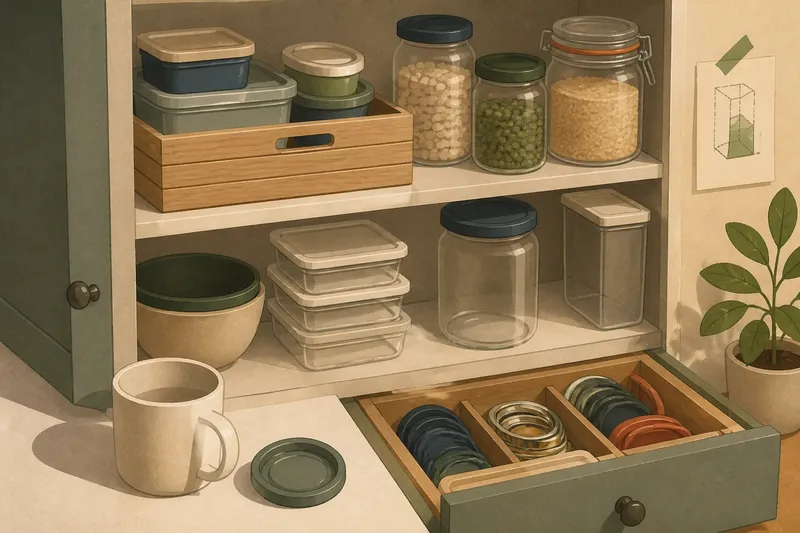
You open the cupboard for a mug and a loose lid slides onto the counter. Behind it, a stack of jars waits for a future batch of something, though you cannot remember the last time you reached for one. A spare-container stash can be useful, but only when its contents have a likely job and a proper place to wait.
Keeping a container because it might come in handy feels thrifty. The trouble starts when possibility becomes the only reason to keep it. A deliberate limit makes the stash easier to use: keep containers that fit tasks you actually do, in amounts your storage can comfortably hold, and release the rest.
Storage Becomes the Problem
What happens: Jars occupy the front of a shelf, lids collect in a separate drawer, and everyday dishes get pushed aside. You may even find yourself moving containers to reach other things.
What causes it: The collection grows one item at a time, while the available space stays the same. Each container looks small on its own, so it is easy to miss how much room the whole stash has claimed.
What to try: Pick one clearly bounded home for reusable containers: perhaps a single cupboard shelf, a crate in the pantry, or one section of a deep drawer. Put the containers there, then treat the boundary as the limit rather than adding another overflow spot.
Choose a boundary that leaves room for the items you use every day. A container stash should not make you rearrange a cupboard each time you reach for a bowl. If your shelf is shallow, keep a compact selection that nests; if you have a roomy pantry, you may have space for a few distinct shapes. The available space is a practical constraint, not a challenge to fill every inch.
Useful Shapes Get Buried
What happens: When you want a container for leftovers or pantry odds and ends, you dig past jars with narrow necks, unusually broad tubs, or lids that seem to belong to something else. The stash is full, but the right item is hard to find.
What causes it: A collection built on “this could be useful” tends to include shapes that do not match the tasks at home. A narrow-neck bottle might be awkward for scooping dry beans. A wide, shallow tub might not fit on the shelf where you keep lunch items.
What to try: Start with the jobs you already have. Think about the leftovers you store, the small amounts of food you transfer into the pantry, or the occasional item you need to carry. Keep containers whose shapes suit those jobs instead of trying to preserve one of every type.
Shape and opening matter as much as capacity. A wide mouth is easier to fill and clean than a narrow one; a flat container may stack neatly but take up more shelf width. Look at the space where the container would be used, not just at how appealing it looks empty on the counter.
Lids Lose Their Partners
What happens: You find a useful-looking tub but cannot locate its lid, or you uncover a lid with no matching base. Both pieces stay because they might be reunited someday.
What causes it: Lids and bases are stored apart, or several containers have similar shapes that make matching uncertain. A loose lid seems easy to keep, but it rarely solves a storage problem by itself.
What to try: Store each container with its matching lid, or keep lids upright in a small divider next to the bases. When sorting, pair each lid with a base before deciding that the set earns space. If a container has no useful match, do not let the orphaned piece become a reason to keep the rest of an unsuitable assortment.
Some lids are designed for a particular container and do not seal reliably with another, even if they appear close in size. Keep sets together when you know they fit; avoid treating “almost fits” as a dependable storage solution.
Possible Uses Stay Vague
What happens: A jar has been in the cupboard through several clean-outs because it could hold buttons, seeds, screws, leftovers, or a gift. None of those uses has yet required that particular jar.
What causes it: A broad list of imagined uses can make nearly any container seem worth saving. But a use that is never part of your routines does not make the item helpful in your home.
What to try: Name the likely job before keeping a container. “Small jar for the loose tea I buy regularly” is more useful than “jar for something someday.” If the job is occasional, keep only the number you are likely to need at once, not every container that could serve it.
Say you regularly bring home a few small portions of soup from a neighbor and like to return the containers. You could set aside a small group of sturdy, similarly shaped tubs that stack on the shelf where leftovers go. When that space is full, another tub has to replace one already there rather than expanding the collection; the expected result is a set that is easy to find and return, without a second pile elsewhere.
Cleaning Adds Hidden Work
What happens: Sticky jars wait by the sink, labels leave residue, or containers with narrow corners are unpleasant to wash. The stash requires a chore before it can become useful.
What causes it: A container may be technically reusable but ill-suited to the way you care for household items. Intricate shapes and stubborn labels can demand more attention than the container is worth to you.
What to try: Favor forms that are easy to rinse, dry, and store. Before keeping an empty container, consider whether you would willingly clean it and whether it will dry without trapping moisture. If you already know a particular shape is a nuisance, that is useful information for future choices.
Not every package needs a second life at home. If it is hard to clean, awkward to store, or unsuitable for the task you had in mind, letting it go is not a failure of resourcefulness. The effort spent managing a pile can outweigh the modest convenience of preserving one more container.
How Much Is Enough?
How do I choose a limit for a spare-container stash?
Use the storage space you can spare and the jobs you repeat as your guide. Stop when the designated shelf or crate is comfortably full, rather than making room by displacing everyday items.
Should I keep glass jars or plastic tubs?
Keep the materials and shapes that suit your actual tasks and care habits. If a container’s condition or intended use is uncertain, check its label or manufacturer guidance before using it for food storage.
What should I do with unmatched lids?
Try pairing them with the bases you own, then keep only useful, confirmed matches. A lid that has no container it fits is usually taking up space without serving a purpose.
How often should I sort the stash?
There is no need for a fixed schedule. Reconsider it when the space starts to overflow, when you cannot find a suitable container, or when an item has sat through a household change without a likely use.
Let the Limit Hold
Once you have made room for a small, useful group, keep the boundary visible. Nest containers that fit together, store lids where you can match them, and leave a little breathing room so items are easy to remove. When a new container arrives, ask what job it would do and whether there is space for it. If the stash is full, choose the better fit rather than quietly starting a second collection.
A spare-container stash earns its place by making an ordinary task simpler. The point is not to own the largest possible supply of jars, or to find a purpose for every package that enters the kitchen. A modest limit can help you see what you have, care for it with less fuss, and keep the cupboard available for the things you reach for every day.