Before the Laundry Label: How Clothes Were Kept in Use
Before the laundry label, garment care traveled through household routines and shared skills. Follow a gentle weekly rhythm for keeping clothes wearable.
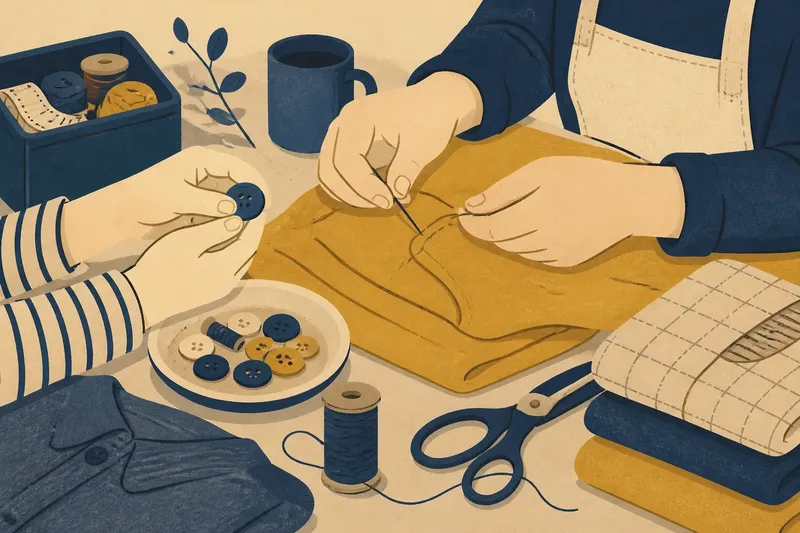
A button drops beside the kitchen chair, and someone slips it into a saucer rather than letting it vanish under the table. Before the laundry label, garment care often began with this kind of small attention: noticing what had changed, then asking a person who knew what to do. The knowledge lived in hands and conversation as much as in any written instruction.
That knowledge was not identical from one household to another. It traveled among relatives, neighbors, apprentices, and paid menders, shaped by the cloth, the work a garment had to do, and the tools available. You can borrow the useful part of that history without trying to recreate an older household: make care a light weekly rhythm, and let each small repair teach you something you can pass along.
Knowledge in company
In many households, a torn seam or loose cuff brought another person into the task. A child might watch an older relative thread a needle; a neighbor might show how to turn a worn collar; a tailor or dressmaker might explain which repair suited a particular cloth. Some knowledge passed through paid work, some through family habit, and some simply because people sat together with the same everyday problem.
Those lessons were concrete. Someone could show how to match thread to a seam, where a patch would rub against the skin, or why a wool garment needed a gentler touch than a sturdy cotton apron. Watching the work made it easier to understand how the cloth behaved. A short exchange could also carry local preferences: a visible mend might be welcome on a child’s play clothes, while a work shirt might call for a repair that lay flat under a jacket.
Care changed with available materials, household routines, and access to skilled help. It was not always leisurely or easy; time, money, and the condition of a garment constrained the choices. Still, useful knowledge could travel through an ordinary task. The point for a household now is not to romanticize the past, but to keep skills shareable rather than leaving every small decision to guesswork.
A week of noticing
Try a routine that takes its cue from the clothes already in use. Choose a consistent moment, such as after putting away clean laundry or before setting out the next day’s outfit. Keep a small tin or shallow dish for loose buttons, a needle, thread in a few common colors, and a pair of fabric scissors. Store sharp tools safely, especially if children are nearby.
On the first check, look over the garments that have just come off rather than starting with a closet-wide inspection. Notice a seam opening, a button that wobbles, a hem coming loose, or a patch of thinning cloth. Separate “repair soon” from “wear carefully for now” and “needs a skilled mender.” The distinction keeps a tiny fix from becoming a vague promise to deal with everything.
On another day, choose one uncomplicated repair you already know how to handle. A loose button or a short seam opening can be a manageable place to begin. Set the garment on a table with good light, find thread that suits the fabric, and take a moment to check how the garment is constructed before you sew. If the cloth is delicate, stretchy, lined, or unfamiliar, asking a knowledgeable person or mender may be the more useful lesson.
Later in the week, show someone what you noticed, even if the repair is not finished. A child can help sort buttons by color, or a friend can identify a tailor who works with a particular fabric. If you are the one learning, ask the person to explain the choice, not just perform the stitch: why place the patch there, or why use that thread? The answer gives you a principle you can recognize next time.
Repairs worth learning
Begin with repairs that preserve the garment’s fit and comfort. A button sewn back securely, a seam closed along its original line, or a hem caught before it unravels can keep a useful item in rotation. Matching the original construction is often more comfortable than adding a bulky fix, especially where a garment touches the body or rubs beneath a bag strap.
Patching asks for a different kind of judgment. A patch needs to cover weakened cloth, but its placement also matters: a stiff edge in the wrong spot can snag or chafe. On a sturdy work garment, a visible patch may suit the item’s purpose. On a light blouse, a repair that changes the drape may be distracting or uncomfortable. Hold the fabric as it would be worn, and consider how the area bends before choosing.
Not every garment is a good home-sewing project. A shaped jacket, a lined coat, a zipper problem, or damage to a fragile fabric may call for a professional with the right equipment. A mender can also tell you when a repair is likely to be uncomfortable or short-lived. Asking for help is part of garment care, not a failure to learn.
What needs a label?
A laundry label can tell you how a maker expects a garment to be washed or dried, but it cannot explain every repair or replace observation. Treat the label and any manufacturer instructions as the starting point when care choices are unclear. Local rules may also apply to services or disposal. Once you know the basic care limits, pay attention to the garment itself: whether the color transfers, whether the fabric stretches, and whether a seam is under strain.
For routine washing, sort by color and fabric needs, close fasteners that might catch, and avoid crowding items together. Airing a garment between wears can be enough when it is not visibly soiled or carrying an odor; frequent washing is not the only way to keep clothes presentable. The right choice depends on use, fabric, and the care information attached to the item.
It is not worth spending an evening trying to make every old garment look untouched. A repair can be sound without disappearing, and some items have reached the point where continued wear is uncomfortable or impractical. Keep the goal modest: notice earlier, choose a suitable response, and make the next useful decision.
Questions about garment care?
How can I tell whether a seam is opening?
Look for separated stitches, a gap that widens when the cloth is gently handled, or a thread pulling away from the seam. If the fabric itself is torn or weakened, simply sewing the opening closed may not hold comfortably.
Can I mend a garment without matching thread?
For an inside seam, a close color match may be less important than thread suited to the fabric and the job. On a visible area, a contrasting thread can look intentional, but consider whether the repair will feel scratchy or stiff.
When should I ask a professional mender?
Ask for help when the garment is lined or shaped, the fabric is delicate, the fastener is complex, or a repair could change fit and comfort. A mender can assess the construction and discuss whether repair makes sense for the particular item.
How do I pass on a repair skill?
Work beside the learner and name the decisions as they arise: where the cloth is weak, what thread you chose, and how you checked the result. Let them try a manageable task on an old garment or fabric scrap, then talk through what felt secure and what needs practice.
Let the lesson travel
Say you notice a shirt cuff beginning to loosen during the week. You set it aside, ask an aunt who sews to show you how she checks the cuff’s stitching, then decide together whether the seam is simple enough to mend at home. Afterward, you tell a housemate what signs to look for in their own shirts. The useful result is not a perfect cuff; it is a shared way of catching the next loose stitch before it becomes a larger problem.
That small exchange is the lasting lesson behind care before the laundry label: clothing knowledge grows when it is visible, specific, and easy to repeat. Keep a basic repair kit within reach, invite someone to show you a technique, and pass along the reasoning as well as the stitch. A garment stays in use through material care, but also through the people who make that care understandable.